Browsed by
Tag: encouragement

A Fine Kettle of Fish

A Fine Kettle of Fish

A Fine Kettle of Fish--An iron kettle filled with fish boiling over an open fireWhether we know it or not, we have all probably ended up in a fine kettle of fish. Life gets messy, and we suffer as a result.

A fine kettle of fish means a difficult situation.

It may be:

  • Awkward
  • Worrisome
  • Frustrating
  • Puzzling
  • Confusing
  • Unpleasant

A pretty kettle of fish means the same.

A fine kettle of fish applies to a variety of circumstances.

A few examples include:

  • Special plans suddenly fall apart.
  • People who dislike one another must work together.
  • Car trouble occurs in the middle of a long trip.
  • Unexpected bills exceed a family’s ability to pay.

This expression probably originated from a Scottish custom.

According to The Free Dictionary, a riverside picnic was called a kettle of fish. Freshly caught salmon were boiled in a kettle over an open fire. The picnics were messy, because everyone ate out of their hands.

People later applied the expression to other messy situations.

When we end up in a fine kettle of fish, we don’t have to stay there.

Our messes may be blessings in disguise. Look for the opportunities they offer.

When possible, let’s turn our messes into ministry.

We often learn the most from our hardest circumstances. In the process, we:

  • Grow stronger.
  • Discover new and better ways to live.
  • Learn how to help others who encounter similar problems.

“For Christ’s sake, I delight in weaknesses, in insults, in hardships, in persecutions, in difficulties. For when I am weak, then I am strong” (2 Corinthians 12:10 NIV).

Image by shumkovpro from Pixabay. Thanks to Laurel Blevins and Karen Hart for the suggestion.

Do you have an expression you want explained or a thought about this one? If so, please comment below.

Subscribe to receive my weekly posts by email and receive a free copy of “Words of Hope for Days that Hurt.”

If you enjoyed this post, please share it with your friends.
Wear Your Heart on Your Sleeve

Wear Your Heart on Your Sleeve

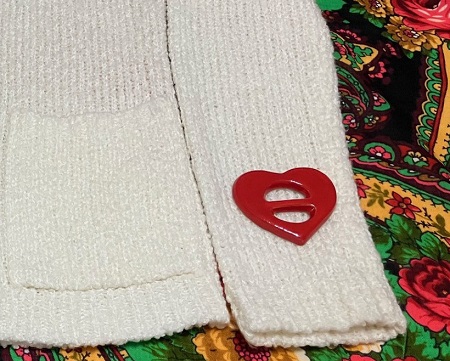
Wear Your Heart on Your Sleeve--a red heart on a white sweater sleeveDo you ever wear your heart on your sleeve? I don’t mean shirts or sweaters with hearts on them. Do you let your emotions show?

When you wear your heart on your sleeve, you openly reveal your emotions.

They become obvious to everyone who sees you. They show in your:

  • Face
  • Words
  • Body Language

Wear your heart on your sleeve applies to every emotion.

  • Anger makes you blow your top.
  • Love brightens the world around you.
  • Concern reaches out to those in need.
  • Fear makes you tremble.

No one has to wonder how you feel, especially when you are in love.

This expression may originate from a medieval custom.

According to The Phrase Finder, knights wore the name of a woman on their sleeves during tournaments.

The phrase later appeared in Shakespeare’s “Othello.”

Wear your heart on your sleeve with caution.

Openness is not appropriate in every situation. You don’t want to go off the deep end. Use wisdom and kindness in all you do.

Allow God’s love to flow through you regardless of your emotions.

When you let go and let God take control, your heart changes for the better.

“I will praise the Lord with my whole heart” (Psalm 111:1 NIV).

Thanks to Brad Leverett for the suggestion.

Do you have an expression you want explained or a thought about this one? If so, please comment below.

Subscribe to receive my weekly posts by email and receive a free copy of “Words of Hope for Days that Hurt.”

If you enjoyed this post, please share it with your friends.

Bumfuzzled

Bumfuzzled

Bumfuzzled--a path among greenery that divides two waysAll of us occasionally feel bumfuzzled. No matter what we do, we cannot find the answers we need.

We don’t know which way to turn or where to look for help. Our brains refuse to work. We are up a stump.

Bumfuzzled means confused.

We feel:

  • Inadequate
  • Frustrated
  • Perplexed
  • Anxious
  • Bewildered

The answer to our bumfuzzled feelings often lies within our reach.

We may simply need to wait, to let it be. For example:

  1. If we relax, the answer frequently pops into our minds.

This happens for many of us in the middle of the night. I keep paper and pens in a bedside drawer for such moments.

  1.  Physical activity also helps.

Increased blood flow improves our brains as well as our bodies.

Our change of focus makes everything fall into place.

  • Confusion melts away.
  • Vexation turns to vision.
  • Purpose and meaning return.

We don’t need to sweat it when we find ourselves overwhelmed and unable to function.

However, we don’t want to stay there.

When we finally find what we need, we make a remarkable discovery. Along with the answers we sought, we also gained persistence and endurance.

“The Spirit helps us in our weakness. We do not know what we ought to pray for, but the Spirit himself intercedes for us through wordless groans”. (Romans 8:26)

Do you have an expression you want explained or a thought about this one? If so, please comment below.

Subscribe to receive my weekly posts by email and receive a free copy of “Words of Hope for Days that Hurt.”

If you enjoyed this post, please share it with your friends.
Burn the Midnight Oil

Burn the Midnight Oil

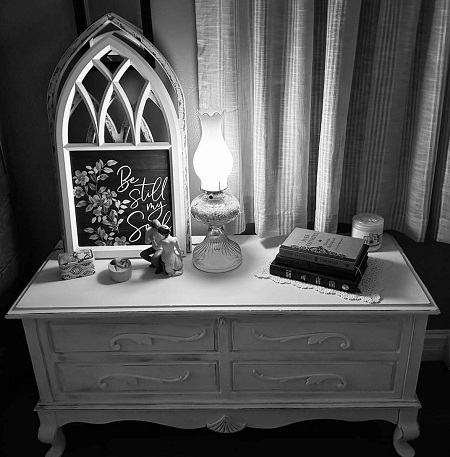
Burn the Midnight Oil--chest with burning oil lamp, "Be Still" plaque, trinkets, and BibleThe night before final exams, students often burn the midnight oil. They study late hoping to make good grades.

To burn the midnight oil means to stay up late studying or working.

Before electricity, people used oil lamps or candles for light after dark. If they stayed up until midnight or after, they used extra oil.

This expression appeared in a 1635 poem, “Emblems,” by Francis Quarles.

People often burn the midnight oil because they fail to study or work during regular hours.

If they work harder earlier, they enjoy a job well done plus a good night’s sleep.

Work or study occasionally requires extra effort.

In those cases, late work must be done to complete the task.

Whether we burn the midnight oil or complete our work early, we need occasional breaks.

Instead of burning the candle at both ends, we need time to:

  • Be still in God’s presence.
  • Let God’s peace fill us.

“At midnight I rise to give you thanks for your righteous laws” (Psalm 119:62 NIV).

Thanks to Becky Nash Rowe for the suggestion and to Jeri Stone for the photo.

Do you have an expression you want explained or a thought about this one? If so, please comment below.

Subscribe to receive my weekly posts by email and receive a free copy of “Words of Hope for Days that Hurt.”

If you enjoyed this post, please share it with your friends.

Brush Up

Brush Up

Brush Up--cluttered deskI frequently need to brush up my desk and my online skills. Both take time, but both are worth the effort. If I don’t clean my desk, the clutter becomes unmanageable. If I fail to refresh or improve my online skills, my writing suffers.

To brush up has at least three meanings.

  1. To clean with a brush.

This might include:

  • Crumbs from a table
  • Dirt off the floor
  • Dust from a porch
  1. To clean or improve something (with or without a brush).

In addition to my desk, I need to clean or update the rest of the house. I have no problem with getting the house clean as a whistle.  However, I don’t like change, so I update only when necessary.

I also need to occasionally update my:

  • Medical information
  • Résumé
  • Contacts
  1. To improve personal knowledge or abilities.

I learn new information or review what I already know. That refreshes my memory and improves my abilities as a:

  • Writer
  • Caregiver
  • Bible study leader for middle school girls
  • And other roles

What about you? Where do you have to brush up? Please comment.

“Grow in the grace and knowledge of our Lord and Savior Jesus Christ.” (2 Peter 3:18 NIV).

Thanks to Melissa Bright for the suggestion.

Subscribe to receive my weekly posts by email and receive a free copy of “Words of Hope for Days that Hurt.”

If you enjoyed this post, please share it with your friends.

No Bigger than a Minute

No Bigger than a Minute

No Bigger than a Minute--Diana with nephewSome expressions suit us to a T.  This one describes me. All my life, I have been the smallest or one of the smallest in most settings.

  • Smallest person in my family
  • One of the smallest in my classes at school
  • Smallest in my office
  • Usually smallest in sports

You get the picture. Here I stand with my then 15-year-old nephew. The gentle giant with the shrimp of the family.

What makes this picture more fun: He was born tiny and premature. I was a big full-term baby.

No bigger than a minute means very small.

The expression often refers to a person who looks:

  • Tiny
  • Skinny
  • Frail
  • Hungry

This can also refer to animals or objects.

Abandoned baby animals look frail and hungry. In addition to food, they need tender loving care.

This expression has a few variations.

Although poor grammar, the following are common.

  • Weren’t no bigger than a minute
  • Ain’t bigger than a minute

 Anyone or anything no bigger than a minute can make a big difference.

Regardless of our size (or any other characteristic), God can use us to make the world a better place. Let’s work together — gentle giants, shrimps, and everyone in between — to spread God’s love with a hurting world.

“He will bless those who fear the Lord—small and great alike” (Psalm 115:13 NIV).

Thanks to Ann Klotz for the suggestion.

Do you have an expression you want explained or a thought about this one? If so, please comment below.

Subscribe to receive my weekly posts by email and receive a free copy of “Words of Hope for Days that Hurt.”

If you enjoyed this post, please share it with your friends.

Sleep Like a Log

Sleep Like a Log


Sleep Like a Log--large log with branches still attached before a tall treeI rise early most mornings. However, caregiving, especially getting up several times a night, occasionally wears me down. If I become extremely tired and have few interruptions, I sleep like a log.

Recently, after days of meeting myself coming and going, I slept almost two hours past my usual wakeup. I felt wonderful! A good night’s sleep solves a lot of life’s woes!

To sleep like a log means a deep, restful sleep.

Similar expressions include sleep like a:

  • Baby
  • Top
  • Rock

All mean to sleep:

  • Well
  • Soundly
  • Without waking

To sleep like a log can be dangerous.

Although we want to sleep soundly, we can overdo it. A friend in college slept so well that other people in his dorm had to wake him when his alarm went off. I once slept through a tornado warning. Someone finally realized I was missing and woke me.

Several steps help achieve a good night’s rest.

  • Go to bed and get up about the same time every day.
  • Keep the room free of distractions.
  • Maintain a regular pre-sleep routine.
  • Eliminate screen time an hour or more before going to bed.

God gave us the gift of sleep. Let’s make the most of it.

“In peace I will lie down and sleep, for you alone, Lord, make me dwell in safety” (Psalm 4:8 NIV).

Thanks to Joanne Viola for the suggestion.

Do you have an expression you want explained or a thought about this one? If so, please comment below.

Subscribe to receive my weekly posts by email and receive a free copy of “Words of Hope for Days that Hurt.”

If you enjoyed this post, please share it with your friends.
Misery Loves Company

Misery Loves Company

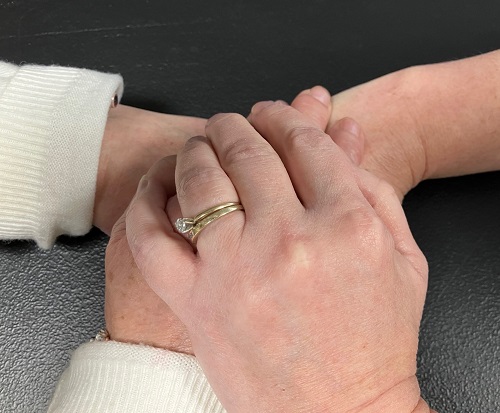
Misery Loves Company--someone grasping another person's hands When we feel bad, knowing other people share our feelings encourages us. Misery loves company.

To have friends or family tell us they have experienced our troubles helps us feel better. If they go through their problems the same time as ours, we support one another.

Misery loves company means we hate to suffer alone.

Mutual pain makes our pain easier to bear.

Misery loves company sometimes comes from a mean motive.

  • If we hurt, we want others to hurt.
  • If we feel down in the dumps, we want everyone down in the dumps too.
  • If we fail, we want the world to fail.

We think everyone should feel as bad as we do.

Other times, our motives remain pure.

We don’t want others to suffer. Yet, it helps to know we are not alone. Having someone who understands from experience makes a big difference. We:

  • Trust them
  • Feel comfortable with them
  • Cry with them
  • Laugh with them
  • Pray for better days ahead

Friends help friends in good times and bad.

In all life’s ups and downs, we remain there for one another. I appreciate the prayers and love so many of you have expressed in recent years.

“It was good of you to share in my troubles” (Philippians 4:14 NIV).

Thanks to Janna Babak for the suggestion.

Do you have an expression you want explained or a thought about this one? If so, please comment below.

Subscribe to receive my weekly posts by email and receive a free copy of “Words of Hope for Days that Hurt.”

If you enjoyed this post, please share it with your friends.
Work Wonders

Work Wonders

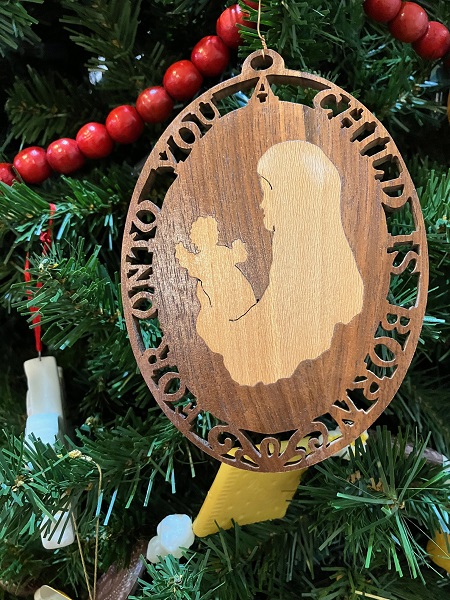
Work Wonders-- wooden Christmas ornament--Mary and baby Jesus in center--"For unto you a child is born cut out around the edges

This hand-crafted ornament came from a local school’s art fair. I watched the craftsman work wonders with simple pieces of wood.

To work wonders means to create an excellent outcome.

My dad also produced amazing woodwork. I have examples throughout our house. You can find one in my explanation of “Make Do.”

Although successful in his craft, Dad did not make money from it. Instead, he gave away almost everything he created. He defined success as helping others.

After a busy day, rest works wonders for minds and bodies.

Whatever work we do, we need time away from it. Other wonder-working aids include:

  • Proper nutrition
  • Regular exercise
  • Social interaction
  • Ongoing learning
  • Daily devotions

All help us be our best selves.

The greatest wonder of history came in the form of a baby.

  •  Jesus left the splendor of heaven to be born to a peasant family.
  • He left absolute safety for a life of danger.
  • God in flesh died so we might have life.
  • He arose from the grave and has prepared a home in heaven for all who follow Him.

That is what Christmas is all about. God who works wonders. Immanuel — God with us.

Merry Christmas!

“The virgin will conceive and give birth to a son, and they will call him Immanuel” (which means ‘God with us’)” (Matthew 1:23 NIV).

Thanks to Tracy Crump for the suggestion.

Do you have an expression you want explained or a thought about this one? If so, please comment below.

Subscribe to receive my weekly posts by email and receive a free copy of “Words of Hope for Days that Hurt.”

If you enjoyed this post, please share it with your friends.

Bridge the Gap

Bridge the Gap

Bridge the Gap--swinging bridge among trees and plants

On a mission trip several years ago, a subway recording told us to mind the gap. That warning to watch our step prevented accidents. More important than minding the gap, our team wanted to bridge the gap.

To bridge the gap means to serve as a bridge.

We connect two:

  • Points
  • People
  • Groups of people

We bridge the gap when we build physical bridges.

Many of us love old swinging bridges. However, most bridges today are stronger, safer, and not as scary. All bridges make it easier to get from one place to another.

We also build relationship bridges.

Two people or groups of people may disagree or misunderstand one another. To bridge the gap, we unite them. Gaps occur in:

  • Beliefs
  • Languages
  • Goals

To bridge the gap relieves a problem.

If we:

  • Need money, we request a loan.
  • Feel overwhelmed, we seek support.
  • Require help, we ask for assistance.

Jesus bridges the gap between God and people.

That was the message our mission team shared.

Our sins or wrongdoings separate us from the one and only holy God. Jesus came to earth to pay the price for our sins. He:

  • Lived a sinless life.
  • Died on a cross to pay the price for our sins.
  • Rose from the dead on the third day, defeating sin and death.

Jesus solved our sin problem. When we turn from our wrongs and give control of our lives to Jesus, we cross the bridge from death to eternal life.

As we celebrate Christmas, may we never forget the reason Jesus came.

“Very truly I tell you, whoever hears my word and believes him who sent me has eternal life and will not be judged but has crossed over from death to life” (John 5:24).

Thanks to Beckham Wilson for the suggestion.

Do you have an expression you want explained or a thought about this one? If so, please comment below.

Subscribe to receive my weekly posts by email and receive a free copy of “Words of Hope for Days that Hurt.”

If you enjoyed this post, please share it with your friends.