
Browsed by
Tag: idiom

Close-knit

Close-knit

Close-knit--family photoDo you have a close-knit family or group of friends? Few things in life replace those special relationships. Your roots may have run deep for a long time. Or you may have known one another only briefly. Either way, you can depend on one another.

Close-knit means a close relationship.

Your ties to one another may result from shared:

  • Family
  • Friends
  • Culture
  • Interests

Whatever holds you together stays strong.

Time or distance don’t reduce your close-knit commitment.

You remain ready to move heaven and earth for one another at a moment’s notice. Just call, and help is on the way.

That’s the kind of relationship everyone needs.

You never have to wonder. You never have to worry. If you need them, they will be there.

God offers a never-failing close-knit relationship to everyone.

People have limits. God has none. If you want the best of the best, turn to God. God will never leave you alone.

“No one has ever seen God, but the one and only Son, who is himself God and is in closest relationship with the Father, has made him known” (John 1:18 NIV).

 Thanks to Beckham Wilson for the suggestion.

Do you have an expression you want explained or thoughts about this one? If so, please comment below.

Subscribe to receive my weekly posts by email and receive a free copy of “Words of Hope for Days that Hurt.”

If you enjoyed this post, please share it with your friends.

Off the Top of My Head

Off the Top of My Head

Off the Top of My Head--two facing head outlines filled with booksHave you ever felt swamped with work, and someone asked you a question? Perhaps you began your response with, “Off the top of my head …”

Off the top of my head means you reply with little thought.

Your answer requires minimal brain power. However, if you fail to check your memory, your guess might not be right.

Off the top of my head works best if you know your subject well.

The most reliable information comes from experts in the field.

  • Plumbers know how to fix leaky faucets.
  • Doctors understand health issues.
  • Chefs prepare tasty food.

Experts often consult with one another since two heads are better than one.

Verifying usually works best.

Therefore:

  • Reliable plumbers check leaks.
  • Trustworthy doctors perform tests.
  • Top chefs try recipes before they share them.

They investigate before they act—a valuable lesson for everyone.

“Do not be quick with your mouth, do not be hasty in your heart to utter anything before God. (Ecclesiastes 5:2 NIV).

Thanks to Melissa Bright for the suggestion. Image by Gerd Altmann from Pixabay.

Do you have an expression you want explained or thoughts about this one? If so, please comment below.

Subscribe to receive my weekly posts by email and receive a free copy of “Words of Hope for Days that Hurt.”

If you enjoyed this post, please share it with your friends.

On the Tip of Your Tongue

On the Tip of Your Tongue

On the Tip of Your Tongue -- dog with tongue outHave you ever had someone’s name on the tip of your tongue? You know the person well, but the name simply will not come to mind.

On the tip of your tongue means something you can almost remember.

The thought is nearly there but not quite. When you start to say it, it disappears. You could kick yourself, but that would do no good.

On the tip of your tongue refers to more than names.

People often forget:

  • Answers to questions
  • Thoughts
  • Quotes
  • Words

The inability to recall information affects everyone.

However, certain conditions make the situation worse.

  • Age
  • Stress
  • Multi-tasking
  • Distractions
  • Illness

Those and other circumstances often make the brain work at a snail’s pace.

Humor helps when anything remains on the tip of your tongue.

Like water off a duck’s back, let it go. Learn to laugh at yourself. You are not alone.

Aren’t you glad God never forgets?

Never has. Never will.

“Before a word is on my tongue you, Lord, know it completely” (Psalm 139:4 NIV).

Thanks to Lindy Pierce for the suggestion and to Chelsey Stone for the photo.

Do you have an expression you want explained or thoughts about this one? If so, please comment below.

Subscribe to receive my weekly posts by email and receive a free copy of “Words of Hope for Days that Hurt.”

If you enjoyed this post, please share it with your friends.

Mayday

Mayday

Mayday--helicopters at Ft. Campbell, KYOld movies often show someone in trouble who calls, “Mayday! Mayday! Mayday!”

Mayday is an internationally recognized radiotelephone signal for help.

The person, usually on a ship or in an airplane, is in crisis. Problems may include:

  • A fire
  • Engine trouble
  • A collision

If the person in the thick of it survives, it may be on a wing and a prayer.

According to The Free Dictionary, mayday originated with the French phrase, m’aider.

M’aider means “Help me.” Danger threatens.

Mayday now includes other difficulties or dangers.

Most of us have experienced the stress of major and minor disasters.

  • Storms destroy property.
  • Appliances stop working.
  • Cars break down.
  • Electronics die.

Mayday should not be confused with May Day, the May 1 springtime celebration.

May 1 is also Labor Day in some countries.  

 When emergencies arise, God directs us to help one another.

God comforts us. Yet, God also guides us to help the hurting. Shared love and support encourage us to get a grip and keep on keeping on.

“The Lord is good, a refuge in times of trouble. He cares for those who trust in him” (Nahum 1:7 NIV).

Thanks to Mike Bertoglio for the suggestion.

Do you have an expression you want explained or thoughts about this one? If so, please comment below.

Subscribe to receive my weekly posts by email and receive a free copy of “Words of Hope for Days that Hurt.”

If you enjoyed this post, please share it with your friends.
In a Pickle

In a Pickle

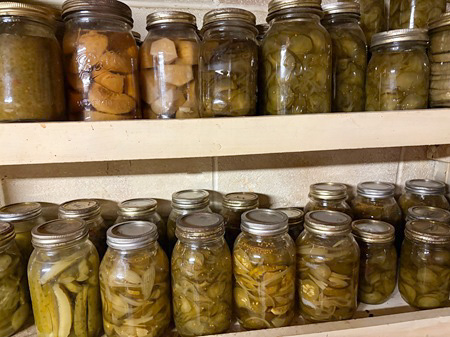
In a Pickle--two shelves of assorted picklesA friend recently said, “I don’t like to put you in a pickle.” She did not want her plans to cause me trouble.

In a pickle means in a difficult situation.

Similar expressions include in a jam or in hot water.

We often end up in a pickle or in a jam through no fault of our own.

  • Circumstances work against us.
  • People’s actions hurt us.
  • Weather destroys our property.
  • Sickness strikes our family.

We have no control over those situations.

Occasionally we get ourselves in a pickle or in hot water.

Our actions work against us when we:

  • Mistreat others
  • Break laws or rules
  • Refuse to work

Sometimes we add words to this expression.

Examples include:

  • In a pretty pickle.
  • In a right pickle.
  • In a real pickle.

However we say it, we get in a mess.

Simple steps may help us out of our messes.

  • Request help from friends, family, or coworkers.
  • Apologize for mistakes.
  • Pray for God’s guidance.

“I cling to your commands and follow them as closely as I can. Lord, don’t let me make a mess of things” (Psalm 119:31 TLB).

Thanks to Rita Smalley for the suggestion and to Gail Gosser for the photo.

Do you have an expression you want explained or thoughts about this one? If so, please comment below.

Subscribe to receive my weekly posts by email and receive a free copy of “Words of Hope for Days that Hurt.”

If you enjoyed this post, please share it with your friends.

Bring Home the Bacon

Bring Home the Bacon

Bring Home the Bacon--children chasing a greased pigYears ago, a husband’s job was to bring home the bacon. Wives took care of the home and children. Today, they often share those responsibilities.

To bring home the bacon means to earn money.

In most cases, the person:

  • Has a job
  • Receives a salary
  • Provides for the family or others

Bring home the bacon also means to be successful.

The person wins or achieves desired results. That holds true in both employment and sports. The bacon may include:

  • A prize
  • Position
  • Money

Two possible origins frequently appear for this expression.

  1. In greased pig contests, whoever catches the pig often receives it as a prize. That occurs at county fairs and other special events.
  2. In the twelfth century, people who proved devotion to their marriage were awarded a pig.

Hard work offers great rewards.

Bringing home the bacon in the form of a paycheck is nice, but so is the satisfaction of a job well done. Everyone benefits from quality work. The fruit of good labor is sweet indeed.

“That each of them may eat and drink, and find satisfaction in all their toil—this is the gift of God” (Ecclesiastes 3:13 NIV).

Thanks to Gail Gosser for the suggestion and to Charlie VanLeuven, editor of The Casey County News for the photo.

Do you have an expression you want explained or thoughts about this one? If so, please comment below.

Subscribe to receive my weekly posts by email and receive a free copy of “Words of Hope for Days that Hurt.”

If you enjoyed this post, please share it with your friends.

Hurkle-durkle

Hurkle-durkle

Hurkle-durkle--sleeping baby with open hand against faceThis little guy knows how to hurkle-durkle. We could all probably take a lesson from him.

I had never heard this expression until recently. However, it has become popular on social media.

What is hurkle-durkle?

According to a Good Housekeeping article by Arricca Elin SanSone, hurkle-durkle is a Scottish expression. It means “to lie in bed or to lounge after it’s time to get up or go to work.”

It allows extra time to rest and relax before starting the day.

Is hurkle-durkle a good practice?

Yes and no.

We all need more rest occasionally. Especially after a tiring day or week.

However, we don’t want to overdo a good thing. Too much dillydallying can result in:

  • Job loss
  • Missed opportunities
  • Unfinished chores

Don’t waste time.

Rest to stay healthy. A lazy day now and then uplifts body and soul. Too many days sleeping in leave us out of shape physically and spiritually.

“‘Let me sleep a little longer! Sure, just a little more!” (Proverbs 6:10 TLB).

Thanks to Carol Edwards for the suggestion and to Savannah Gregory Ramos for the photo.

Do you have an expression you want explained or thoughts about this one? If so, please comment below.

Subscribe to receive my weekly posts by email and receive a free copy of “Words of Hope for Days that Hurt.”

If you enjoyed this post, please share it with your friends.

Half-baked

Half-baked

Half-baked--strawberry cupcakesI don’t like half-baked food, do you? Instead, like these beautiful cupcakes, bake everything until fully done. Yum!

Half-baked means partly baked.

Half-done food:

  • Rarely tastes good
  • May not be safe

Anything half-baked, food or nonfood, is incomplete.

Poor planning and practice doom our projects. Success requires good judgement in preparation and procedure.

Half-baked also means foolish.

Ideas are:

  • Impractical
  • Uninformed
  • Unrealistic

Impolite descriptions include:

  • Stupid
  • Crazy
  • Brainless

Such ideas often result from a lack of maturity or experience.

However, age and ability don’t guarantee wise judgement. Neither do youth and a lack of experience mean certain failure.

At any age or skill level, we gain when we:

  • Take our time.
  • Plan well.
  • Work hard.

If we want to take the cake, we can’t use half-baked ideas.

God never offers partial plans.

In a recent sermon, our pastor described a half-baked or half-done scheme. Because of poor planning and performance, it failed.

However, God never does anything halfway. We find the ultimate example of God’s complete work in Jesus. Sent to earth as the perfect sacrifice for our sins, Jesus saves us entirely and eternally.

God gives the best. Never settle for less.

“My people mingle with the heathen, picking up their evil ways; thus they become as good-for-nothing as a half-baked cake!” (Hosea 7:8 TLB).

Thanks to Pastor Dwayne Norman for the idea and to Carol Sullivan for the photo.

Do you have an expression you want explained or thoughts about this one? If so, please comment below.

Subscribe to receive my weekly posts by email and receive a free copy of “Words of Hope for Days that Hurt.”

If you enjoyed this post, please share it with your friends.
With a Grain of Salt

With a Grain of Salt

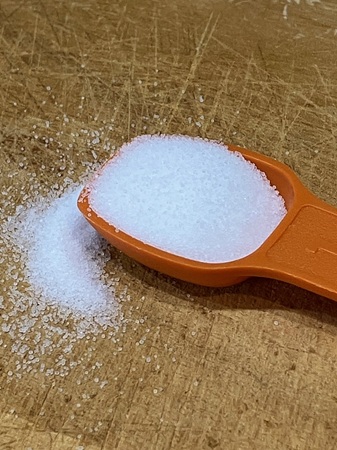
With a Grain of Salt--teaspoon spilling saltSocial media content should be taken with a grain of salt. Along with helpful information, we find untruths and half-truths.

To take with a grain of salt (or a pinch of salt) means with hesitation.

We verify rather than accept without reservation. Especially if we don’t know the information source. Such caution applies to more than social media.

  • Many sources remain reliable and honest.
  • Others, not worth their salt, share unreliable and dishonest material.

Unreliable sources often make a bad situation worse.

They harm instead of help. Although we want to believe information, we often find:

  • Exaggeration
  • Deliberate deceit
  • Unintended untruth

According to The Free Dictionary, with a grain of salt “is a translation of the Latin cum grano salis.”

Pliny used it to describe “Pompey’s discovery of an antidote for poison (to be taken with a grain of salt).”

Let’s always speak truth and guide others to do the same.

Season rather than harm. Preserve rather than destroy.

“Let your conversation be always full of grace, seasoned with salt, so that you may know how to answer everyone” (Colossians 4:6 NIV).

Thanks to Joyce McCullough for the suggestion.

Do you have an expression you want explained or thoughts about this one? If so, please comment below.

Subscribe to receive my weekly posts by email and receive a free copy of “Words of Hope for Days that Hurt.”

If you enjoyed this post, please share it with your friends.
Chopped Liver

Chopped Liver

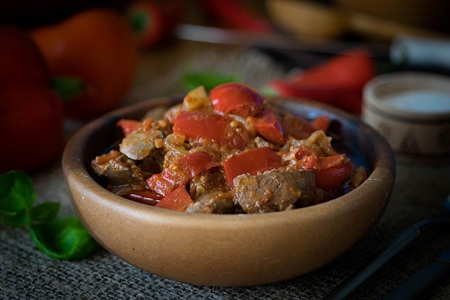
Chopped Liver--bowl of chopped chicken liverDoes anyone out there like chopped liver? I tried to eat it by:

  • Hiding it in mashed potatoes
  • Holding my nose
  • Breading it and adding spices

Nothing worked. It still tasted like liver. I know liver is good for me, but I don’t like it. I consider it a dish for the birds.

Whether we eat it or not, we sometimes feel like chopped liver.

No matter how hard we try:

  • Not everyone likes us.
  • Many overlook us.
  • Few appreciate our potential.

Chopped liver means worthless.

We judge a person or thing as:

  • Unpleasant
  • Unimportant
  • Undesirable

Emotional responses to such treatment include:

  • Sadness
  • Anger
  • Disappointment
  • Defeat
  • Frustration

A common verbal response is, “So what am I? Chopped liver?”

We may say this when:

  • We fail to get a job.
  • Friends reject us.
  • People make fun of us.

According to The Free Dictionary, this expression “likely originated as a part of Jewish humor.”

It probably refers to “chopped liver as a common side dish.”  It was “overlooked in favor of the main course.” Many people dislike its taste.

We may consider chopped liver as good only for garbage. Yet, we never want to treat one another that way.

“To love [God] with all your heart, with all your understanding and with all your strength, and to love your neighbor as yourself is more important than all burnt offerings and sacrifices” (Mark 12:33 NIV).

Thanks to Joan Borton for the suggestion. Photo courtesy of Pixabay.

Do you have an expression you want explained or thoughts about this one? If so, please comment below.

Subscribe to receive my weekly posts by email and receive a free copy of “Words of Hope for Days that Hurt.”

If you enjoyed this post, please share it with your friends.