Browsed by
Tag: Bible

The Patience of Job

The Patience of Job

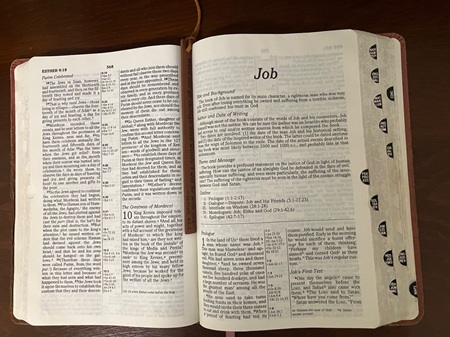
The Patience of Job--Bible open to book of JobDo you know people with the patience of Job? Those I admire include:

  • Parents with a houseful of children
  • Teachers with rowdy, disrespectful students
  • Doctors with full waiting rooms who take time to answer questions

The patience of Job refers to people with great patience.

They stay calm in the middle of chaos. They treat others with kindness — even those rude to them.

People with the patience of Job endure through every circumstance.

They rarely waver despite:

  • Illness
  • Financial problems
  • Relationship struggles
  • Work overload

The patience of a saint means the same.

We often wonder how those people stay cool as a cucumber while others sweat bullets.

They rarely:

  • Yell
  • Act frustrated
  • Blame others

Instead, they:

  • Speak quietly
  • Do what needs to be done
  • Take responsibility when they do anything wrong

This expression refers to Job, a man in the Bible, who lost almost everything.

His losses included:

  • All his children
  • Possessions
  • Health

Job could not understand his suffering but stood firm in his faith.

Although he received little support from people, he relied on God.

Eventually:

  • Job’s health was restored.
  • He had more children.
  • His possessions doubled.

One constant for Job: Through all his ups and downs, God was always there.

“I know that my redeemer lives, and that in the end he will stand on the earth. And after my skin has been destroyed, yet in my flesh I will see God” (Job 19:25-26 NIV).

Thanks to Jessi Gowen for the suggestion.

Do you have an expression you want explained or thoughts about this one? If so, please comment below.

Subscribe to receive my weekly posts by email and receive a free copy of “Words of Hope for Days that Hurt.”

If you enjoyed this post, please share it with your friends.

Peanuts

Peanuts

Peanuts-squirrel eating peanuts from a feederOne of my cousins had the childhood nickname, Peanut. Like me, she was tiny, no bigger than a minute. Family and friends were not making fun of her. They loved her and thought she was cute as a button. In fact, they loved all the peanuts among us.

In addition to snack food, peanuts refer to tiny people or small amounts of money.

Good food. Good people. Not so good on a paycheck.

Although small, peanuts we eat have much to offer.

  • Great taste
  • Healthy fats
  • Plant-based protein

People who are peanuts also offer much.

Small does not mean weak. We can be:

  • Strong
  • Determined
  • Talented

For peanuts means for a small amount of money.

We either pay or receive little for a service. However, when we pay better wages, we usually receive better service. Most of us desire a good day’s pay for a good day’s work.

Peanut gallery means cheap theater seats far from the stage.

It also means people whose opinions receive little or no respect.

The Bible teaches the importance of small things and small people.

Whether small or great, let’s respect one another.

“The kingdom of heaven is like a grain of mustard seed that a man took and sowed in his field. It is the smallest of all seeds, but when it has grown it is larger than all the garden plants and becomes a tree, so that the birds of the air come and make nests in its branches” (Matthew 13:31-32 ESV).

Thanks to Rebecca Stafford for the suggestion. Image by Christiane from Pixabay.

Do you have an expression you want explained or thoughts about this one? If so, please comment below.

Subscribe to receive my weekly posts by email and receive a free copy of “Words of Hope for Days that Hurt.”

If you enjoyed this post, please share it with your friends.

Whistle Past the Graveyard

Whistle Past the Graveyard

Whistle Past the Graveyard-graves at Arlington National CemeteryI grew up near a graveyard. Later, my husband and I built a house across the road from one. We laughed and said we would have quiet neighbors. However, some people fear living so close to graves. They feel the need to whistle past the graveyard.

When we whistle past the graveyard, we hide our fear by acting calm.

We may be afraid of our own shadow. However, we don’t want anyone to know.

Whistling past the graveyard happens often.

In addition to passing a cemetery, we fear:

  • Public speaking
  • Competition for a championship
  • Any embarrassing situation

To whistle past the graveyard may increase courage.

Acting with courage often makes us more courageous. We survive what we fear, so the next time becomes easier.

The Bible tells us we have no need to fear death.

Followers of Jesus know that death and the grave are not the end. When Jesus arose from the grave, He conquered sin and death. We can share that same victory and look forward to an eternal home in heaven.

“Do not be amazed at this, for a time is coming when all who are in their graves will hear his voice” (John 5:28 NIV).

Thanks to Bobbie Smith Bryant and Martha Orlando for the suggestion. Image by Carol Colman from Pixabay

Do you have an expression you want explained or thoughts about this one? If so, please comment below.

Subscribe to receive my weekly posts by email and receive a free copy of “Words of Hope for Days that Hurt.”

If you enjoyed this post, please share it with your friends.
Satisfy Like Honey on a Warm Biscuit

Satisfy Like Honey on a Warm Biscuit

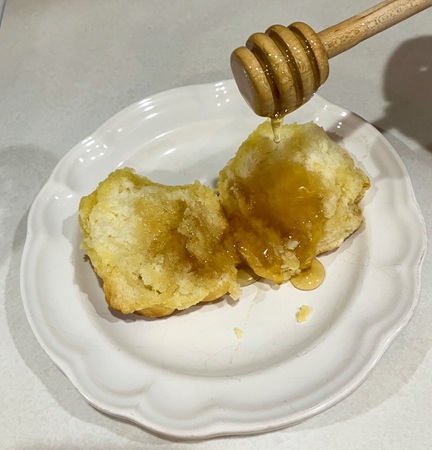
Satisfy Like Honey on a warm biscuit--honey drizzled on a split biscuitCold winter days call for comfort food. Nothing satisfies like honey on a warm biscuit. It fills our stomachs and sticks to our ribs.

To satisfy like honey on a warm biscuit means to comfort or indulge.

As sweet as honey on a warm biscuit is a related simile. SimiliesGuru.com says the expression is used “for cozy, satisfying happiness.”

Our sources of satisfaction differ.

Some of us enjoy a good book. Others prefer a long walk. Many find satisfaction in both.

We may also enjoy:

  • Time with friends and family
  • Travel
  • Naps

Choices vary according to our personalities and interests.

Reading the Bible satisfies better than honey on a warm biscuit.

God’s Word offers:

  • Lessons for daily life
  • The way to eternal life
  • Direction for life decisions

It also reminds us that our words and actions matter. Luke 6:31 tells us to treat others like we want them to treat us. Be as sweet to them as we want them to be sweet to us. Remember, we catch more flies with honey than vinegar.

Seek satisfaction that lasts.

Follow God’s guidance for joy that never fails.

“But you would be fed with the finest of wheat; with honey from the rock I would satisfy you” (Psalm 81:16 NIV).

Thanks to Sharon Berry for the suggestion.

Do you have an expression you want explained or thoughts about this one? If so, please comment below.

Subscribe to receive my weekly posts by email and receive a free copy of “Words of Hope for Days that Hurt.”

If you enjoyed this post, please share it with your friends.

Scapegoat

Scapegoat

Scapegoat--goat lying in field, face to cameraHave you ever been a scapegoat? Something bad happened. It was not your fault, but you received the blame. Or have you ever scapegoated someone else?

A scapegoat receives all the blame or punishment for the wrongs of others.

The person may be innocent or only partially at fault. However, they receive total blame.

  • Family members accuse a relative for all their problems.
  • Company leaders condemn an employee for the company’s losses.
  • Team members blame one player for their team’s defeat.

We don’t like to be accused when innocent.

Neither do other people.

We find the background for a scapegoat in the Bible.

God gave Moses directions for the Day of Atonement. Aaron, Israel’s first high priest, took two male goats for a sin offering. One goat was sacrificed. The other (the scapegoat) had the sins of the people symbolically placed on it. It was then driven into the wilderness.

Rather than condemn others unfairly, let’s:

  • Take responsibility for our own actions.
  • Encourage one another to make wise choices.
  • Forgive the mistakes of others and ask forgiveness for ours.

Let’s not hang one another out to dry. Instead, let’s treat others like we want to be treated.

“He is to lay both hands on the head of the live goat and confess over it all the wickedness and rebellion of the Israelites—all their sins—and put them on the goat’s head. He shall send the goat away into the wilderness in the care of someone appointed for the task.  (Leviticus 16:21 NIV).

Thanks to Karen Atwood for the suggestion and to Lori Carmicle for the photo.

Do you have an expression you want explained or thoughts about this one? If so, please comment below.

Subscribe to receive my weekly posts by email and receive a free copy of “Words of Hope for Days that Hurt.”

If you enjoyed this post, please share it with your friends.
Written in Stone

Written in Stone

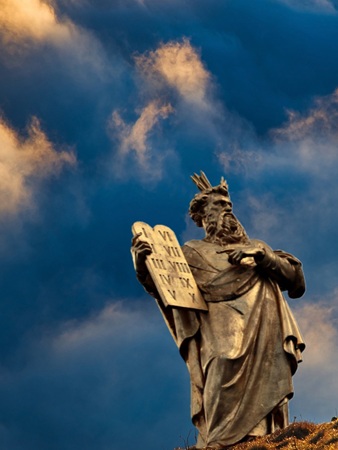
Written in Stone--Statue of Moses with the Ten CommandmentsWhen we receive instructions, we may wonder if they will change or if they are written in stone. That is true for orders from:

  • Parents to children
  • Employers to workers
  • Governments to citizens

Anything written in stone (or set in stone) cannot be changed.

It is:

  • Permanent
  • In final form

Similar expressions include cast in stone or etched in stone.

Written in stone probably originated with the Ten Commandments in the Bible.

Those rules, given by God to Moses, were engraved on stone. They provide direction for every part of our lives.

The first four commandments address our relationship with God.

They tell us to:

  1. Have no other gods before God.
  2. Make no idols.
  3. Never take God’s name in vain.
  4. Remember and keep the Sabbath day holy.

The last six commandments address our relationships with other people.

They tell us to:

  1. Honor our fathers and mothers.

And not to:

  1. Murder
  2. Commit adultery
  3. Steal
  4. Bear false witness
  5. Covet

Years later, a law expert asked Jesus which commandment is greatest.

Jesus replied, “‘Love the Lord your God with all your heart and with all your soul and with all your mind.’ This is the first and greatest commandment. And the second is like it: ‘Love your neighbor as yourself.’ All the Law and the Prophets hang on these two commandments” (Matthew 22:37-40).

Love God. Love others. That covers all the commandments in a nutshell.

Thanks to Tracy Crump for the suggestion. Image by Enlightening Images from Pixabay.

Do you have an expression you want explained or thoughts about this one? If so, please comment below.

Subscribe to receive my weekly posts by email and receive a free copy of “Words of Hope for Days that Hurt.”

If you enjoyed this post, please share it with your friends.

Feet of Clay

Feet of Clay

Feet of Clay--two clay feetHow often do we admire people and think they can do no wrong? Yet, we eventually learn they have feet of clay.

Feet of clay means a failure or weakness.

We have faults. Our heroes have faults. No matter how hard we try to be perfect, everyone falls short of perfection.

This idiom originated in the Bible.

Daniel 2 tells the story of King Nebuchadnezzar and a dream he could not understand. God revealed the dream and its meaning to Daniel, one of the king’s captives. In the dream, a statue had:

  • A head of gold
  • A body of silver, bronze, and iron
  • Feet of iron and clay

A large rock hit the feet, and the statue crumbled.

Daniel told the king his dream meant the Babylonian kingdom would fall. However, God’s kingdom would last forever.

Because we have feet of clay, we find hope only in our Creator.

If we rely on ourselves, we fall flat. However, God’s strength and guidance enable us to stand firm. Like Daniel, may we faithfully follow the one and only true God.

“Praise be to the name of God for ever and ever; wisdom and power are his” (Daniel 2:20 NIV).

Thanks to Meghan Bowker, editor of Missions Mosaic magazine, for the idea. Photo by Matt Seymour on Unsplash.

Do you have an expression you want explained or a thought about this one? If so, please comment below.

Subscribe to receive my weekly posts by email and receive a free copy of “Words of Hope for Days that Hurt.”

If you enjoyed this post, please share it with your friends.

Fruit of Your Labor

Fruit of Your Labor

Fruit of Your Labor--flower and vegetable garden with orchard in backgroundMy dad’s garden and orchard fed our family plus dozens of others. He spent years growing food and flowers as a labor of love. Dad also understood what it means to enjoy the fruit of your labor.

The fruit of your labor means the reward for your work.

Your efforts pay off. Because you refuse to give up, you bear fruit.

Long hours and hard work make you appreciate the fruit of your labor.

  • Farmers harvest their crops.
  • Gardeners enjoy vegetables, fruit, and flowers.
  • Students celebrate graduation.
  • Business owners enjoy profits.

You benefit from your investment of:

  • Time
  • Money
  • Muscle (mental or physical)

The harder the work the more enjoyable the fruit of your labor.

Life may give you long rows to hoe. However, you usually reap what you sow. Greater efforts result in greater rewards.

Make relationships your most important investment.

According to the Bible, the greatest commandments are to love God and love one another. The best fruit does not result from a focus on self. Rather, it grows from love and service.

“Blessed are all who fear the Lord, who walk in obedience to him. You will eat the fruit of your labor; blessings and prosperity will be yours” (Psalm 128:1-2 NIV).

Thanks to Beckham Wilson for the suggestion.

Do you have an expression you want explained or a thought about this one? If so, please comment below.

Subscribe to receive my weekly posts by email and receive a free copy of “Words of Hope for Days that Hurt.”

If you enjoyed this post, please share it with your friends.
Kiss of Death

Kiss of Death

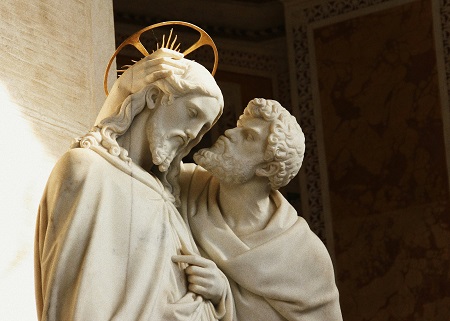
Kiss of Death--statue of Judas kissing JesusA kiss of death means something that causes failure or ruin.

It may be:

  • Actions. Poor attitudes or behaviors often result in the loss of jobs, friendships, or other positions.
  • Relationships. Associating with troublemakers frequently leaves people in trouble.
  • Events. Being in the wrong place at the wrong time can destroy plans.
  • Poor timing. Failures frequently occur because people begin too early or too late to accomplish their purposes.

A kiss of death may look good but result in great harm.

Damage often occurs even if intentions appear helpful. A handshake or endorsement from the wrong people kills countless business deals and reputations.

This expression relates to Judas Iscariot’s kiss that betrayed Jesus.

When religious leaders wanted to rid themselves of Jesus, they enlisted Judas, one of Jesus’ followers, for help. Matthew 26:48-49 records it. “The betrayer had arranged a signal with them: ‘The one I kiss is the man; arrest him.’ Going at once to Jesus, Judas said, ‘Greetings, Rabbi!’ and kissed him” (NIV).  A kiss of death has also been called a Judas kiss.

Not every kiss of death ends in permanent harm.

Although Jesus died on the cross, He arose from the dead on the third day. His death and resurrection conquered sin and death. All who place their faith in Jesus also receive victory over sin and death. That’s the message of Easter. Jesus offers everyone a fresh start, a new beginning.

“He is not here; he has risen, just as he said” (Matthew 28:6 NIV).

Thanks to Terrie Wilson for the suggestion. Photo by Francesco Alberti on Unsplash

Do you have an expression you want explained or a thought about this one? If so, please comment below.

Subscribe to receive my weekly posts by email and receive a free copy of “Words of Hope for Days that Hurt.”

If you enjoyed this post, please share it with your friends.

Beside Myself

Beside Myself

Beside Myself--globe in glassThe first time I went on an international mission trip, I was beside myself with joy. The opportunity before me almost took my breath away.

Beside myself refers to extreme emotion.

 In addition to awe or joy, I may feel intense:

  • Shock
  • Anger
  • Excitement
  • Sadness
  • Worry
  • Panic

Recent news about some of the areas I served leaves me beside myself with grief. I ache for the difficulties my friends now face.

When I am beside myself, I feel out of control.

Strong emotions overwhelm me. I must work to regain a sense of balance—to get a grip.

This phrase appears in the Bible.

The Apostle Paul had shared the story of his encounter with Jesus on the road to Damascus. He had also discussed his life since that time. Festus, the Roman governor, responded in a loud voice, “Paul, thou art beside thyself; much learning doth make thee mad” (Acts 26:24 KJV). Paul explained that he was not crazy but was sharing God’s truth.

If anyone says I am beside myself, I can think of no better reason than God’s call to share eternal truth and love.

“They were all amazed at the greatness of God” (Luke 9:43 NIV).

What about you? What makes you beside yourself?

Thanks to Stan Crump for the suggestion.

Subscribe to receive my weekly posts by email and receive a free copy of “Words of Hope for Days that Hurt.”

If you enjoyed this post, please share it with your friends.