Browsed by
Category: Wisdom

Cut to the Chase

Cut to the Chase

Cut to the Chase--Nine children running in a field with trees behind themChildren know how to cut to the chase. They abandon boring activities and hightail it to their next adventure.

Cut to the chase means to get to the point.

We don’t bother with:

  • Trivial details
  • Information overload
  • Unnecessary actions

We address only what matters most. Forget the minor. Focus on the major.

We often wish people would cut to the chase.

Those brave among us tell them to quit dillydallying, to stop wasting our time. The not-so-brave endure their rabbit chasing until the end finally comes.

This expression has a motion picture history.

When a scene ends and another begins, they “cut” from one scene to the next. This may occur in filming or editing. To cut to the chase means to get to the exciting part of the film. They move from a slow scene and focus on an action shot. Think in terms of:

  • Car chases
  • Police raids
  • Helicopter fights

Movie producers want to keep their audiences interested.

Let’s cut to the chase with our lives.

We do well if we:

  • Focus on the most important.
  • Use every word, action, and attitude to live for and point others to our loving God.

“What I received I passed on to you as of first importance: that Christ died for our sins according to the Scriptures” (1 Corinthians 15:3 NIV).

Thanks to Alma Haste for the suggestion and to Kelsi Wilson and Lorie Richerson for the photo.

Do you have an expression you want explained or thoughts about this one? If so, please comment below.

Subscribe to receive my weekly posts by email and receive a free copy of “Words of Hope for Days that Hurt.”

If you enjoyed this post, please share it with your friends.

Hurkle-durkle

Hurkle-durkle

Hurkle-durkle--sleeping baby with open hand against faceThis little guy knows how to hurkle-durkle. We could all probably take a lesson from him.

I had never heard this expression until recently. However, it has become popular on social media.

What is hurkle-durkle?

According to a Good Housekeeping article by Arricca Elin SanSone, hurkle-durkle is a Scottish expression. It means “to lie in bed or to lounge after it’s time to get up or go to work.”

It allows extra time to rest and relax before starting the day.

Is hurkle-durkle a good practice?

Yes and no.

We all need more rest occasionally. Especially after a tiring day or week.

However, we don’t want to overdo a good thing. Too much dillydallying can result in:

  • Job loss
  • Missed opportunities
  • Unfinished chores

Don’t waste time.

Rest to stay healthy. A lazy day now and then uplifts body and soul. Too many days sleeping in leave us out of shape physically and spiritually.

“‘Let me sleep a little longer! Sure, just a little more!” (Proverbs 6:10 TLB).

Thanks to Carol Edwards for the suggestion and to Savannah Gregory Ramos for the photo.

Do you have an expression you want explained or thoughts about this one? If so, please comment below.

Subscribe to receive my weekly posts by email and receive a free copy of “Words of Hope for Days that Hurt.”

If you enjoyed this post, please share it with your friends.

Half-baked

Half-baked

Half-baked--strawberry cupcakesI don’t like half-baked food, do you? Instead, like these beautiful cupcakes, bake everything until fully done. Yum!

Half-baked means partly baked.

Half-done food:

  • Rarely tastes good
  • May not be safe

Anything half-baked, food or nonfood, is incomplete.

Poor planning and practice doom our projects. Success requires good judgement in preparation and procedure.

Half-baked also means foolish.

Ideas are:

  • Impractical
  • Uninformed
  • Unrealistic

Impolite descriptions include:

  • Stupid
  • Crazy
  • Brainless

Such ideas often result from a lack of maturity or experience.

However, age and ability don’t guarantee wise judgement. Neither do youth and a lack of experience mean certain failure.

At any age or skill level, we gain when we:

  • Take our time.
  • Plan well.
  • Work hard.

If we want to take the cake, we can’t use half-baked ideas.

God never offers partial plans.

In a recent sermon, our pastor described a half-baked or half-done scheme. Because of poor planning and performance, it failed.

However, God never does anything halfway. We find the ultimate example of God’s complete work in Jesus. Sent to earth as the perfect sacrifice for our sins, Jesus saves us entirely and eternally.

God gives the best. Never settle for less.

“My people mingle with the heathen, picking up their evil ways; thus they become as good-for-nothing as a half-baked cake!” (Hosea 7:8 TLB).

Thanks to Pastor Dwayne Norman for the idea and to Carol Sullivan for the photo.

Do you have an expression you want explained or thoughts about this one? If so, please comment below.

Subscribe to receive my weekly posts by email and receive a free copy of “Words of Hope for Days that Hurt.”

If you enjoyed this post, please share it with your friends.
With a Grain of Salt

With a Grain of Salt

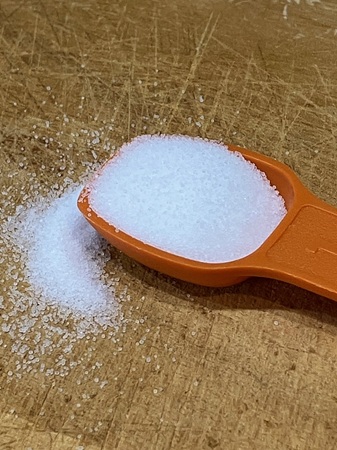
With a Grain of Salt--teaspoon spilling saltSocial media content should be taken with a grain of salt. Along with helpful information, we find untruths and half-truths.

To take with a grain of salt (or a pinch of salt) means with hesitation.

We verify rather than accept without reservation. Especially if we don’t know the information source. Such caution applies to more than social media.

  • Many sources remain reliable and honest.
  • Others, not worth their salt, share unreliable and dishonest material.

Unreliable sources often make a bad situation worse.

They harm instead of help. Although we want to believe information, we often find:

  • Exaggeration
  • Deliberate deceit
  • Unintended untruth

According to The Free Dictionary, with a grain of salt “is a translation of the Latin cum grano salis.”

Pliny used it to describe “Pompey’s discovery of an antidote for poison (to be taken with a grain of salt).”

Let’s always speak truth and guide others to do the same.

Season rather than harm. Preserve rather than destroy.

“Let your conversation be always full of grace, seasoned with salt, so that you may know how to answer everyone” (Colossians 4:6 NIV).

Thanks to Joyce McCullough for the suggestion.

Do you have an expression you want explained or thoughts about this one? If so, please comment below.

Subscribe to receive my weekly posts by email and receive a free copy of “Words of Hope for Days that Hurt.”

If you enjoyed this post, please share it with your friends.
Something Is Afoot

Something Is Afoot

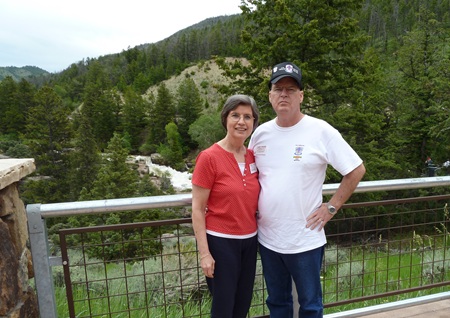
Something Is Afoot--Tim and Diana Derringer at Shell Canyon in Big Horn MountainsMy husband and I loved walks in national, state, and local parks for years. My sister and her husband also enjoyed this area in the Big Horn Mountains. Something is afoot may simply mean someone or something is walking. We travel on foot. However, the expression usually means more.

According to Merriam-Webster dictionary, afoot also means “in the process of development.”

It is underway but not complete. Sometimes we know the plans but not always. Occasionally, it means people have something up their sleeve, a secret plan.

Unknown activity makes us curious.

We try to figure out what is happening. When no one knows, we guess. Anticipation grows.

  • Parents give hints but no details of a planned vacation.
  • Teachers promise a fun activity but leave students in the dark until it begins.
  • Friends take friends on a wild goose chase before a special celebration.

Much is afoot in our world today.

  • Plans have been made.
  • Work is in progress.
  • People look forward to or dread the future.

However, all that can change in an instant.

Unexpected events turn the tables.

  • Storms
  • Wars
  • Illness
  • Death

We want to prepare ourselves for whatever the future holds.

Our lives and our world frequently change. God remains the same.

When we give our lives to God, everything else eventually works out regardless of what is afoot.

“Many are the plans in the mind of a man, but it is the purpose of the Lord that will stand” (Proverbs 19:31 ESV).

Thanks to Cathy Chinn for the suggestion.

Do you have an expression you want explained or thoughts about this one? If so, please comment below.

Subscribe to receive my weekly posts by email and receive a free copy of “Words of Hope for Days that Hurt.”

If you enjoyed this post, please share it with your friends.

The Hand That Rocks the Cradle

The Hand That Rocks the Cradle

The Hand That Rocks the Cradle--vintage doll in cradleIn 1865, William Ross Wallace wrote a poem, “What Rules the World.” According to The Free Dictionary, it later became known as “The Hand that Rules the World.” The poem’s refrain, “The hand that rocks the cradle is the hand that rules the world” has become an often-repeated proverb.

The hand that rocks the cradle refers to the influence mothers have on children.

Mothers guide their children’s overall growth.

  • Social
  • Emotional
  • Physical
  • Mental
  • Spiritual

Think about the power in that position.

The hand that rocks the cradle applies to more than biological mothers.

Some of the most influential include:

  • Foster mothers
  • Adoptive mothers
  • Mothers-in-law
  • Stepmothers
  • Grandmothers
  • Other relatives
  • Friends
  • Neighbors
  • Teachers
  • Anyone who assumes a mother’s role, formal or informal

This Mother’s Day, thank the mothers in your life.

I am so grateful for the positive influence of my mother plus several others in informal mother roles. Many now live in heaven, but their impact remains.

“Her children arise and call her blessed” (Proverbs 31:28 NIV).

What mothers would you add to the list I made. Please comment.

Thanks to Debbie Tapscott for the suggestion and to Virginia Graves for the photo taken at Taylor County Museum – The Heistand House in Campbellsville, KY.

Subscribe to receive my weekly posts by email and receive a free copy of “Words of Hope for Days that Hurt.”

If you enjoyed this post, please share it with your friends.

Spin a Yarn

Spin a Yarn

Spin a Yarn--sailor knotWhen our extended family gets together, a few relatives always spin a yarn. They keep us entertained with their tall tales. Some stories are true or based on truth. Others stretch beyond belief. Most are a hoot.

To spin a yarn means to tell a story.

Often that story is:

  • Long
  • Made-up
  • Full of twists and turns

Sometimes we spin a yarn to stay out of trouble.

We know we did something wrong. To avoid the consequences, we lie or tell a partial truth. However, two wrongs don’t make a right. Not when other people hurt us. Not when we mess up.

This idiom originated with ropes made of long fibers called yarns.

According to The Free Dictionary, “Sailors used to spin yarns … to make ropes. They were also famous for telling unlikely stories of their adventures.”  The nautical term dates from around 1800. We now enjoy the double meaning of “spun fiber” and “a tale.”

Everyone has a story.

From our experiences, we can share lessons of:

  • Hope
  • Joy
  • Peace
  • Love

The Bible holds the greatest story ever told.

  • Life changing
  • All truth
  • Available to everyone

“Give thanks to the Lord, for he is good; his love endures forever. Let the redeemed of the Lord tell their story.” (Psalm 107:1-2 NIV).

Thanks to Beckham Wilson for the suggestion. Image courtesy of Pixabay.

Do you have an expression you want explained or thoughts about this one? If so, please comment below.

Subscribe to receive my weekly posts by email and receive a free copy of “Words of Hope for Days that Hurt.”

If you enjoyed this post, please share it with your friends.
Kick the Tires

Kick the Tires

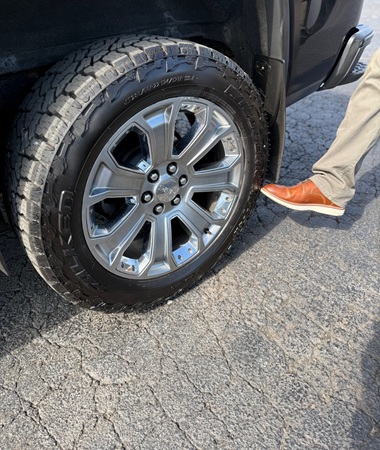
Kick the Tires--foot kicking a tireBefore we buy a car, we want to kick the tires. We check the car inside and out from one end to the other. We drive it and try all its gadgets to be sure they work.

To kick the tires means to test the quality of something.

With any purchase, that includes time to:

  • Inspect
  • Research
  • Analyze

We desire the best product for our money.

We also kick the tires to see if a product meets our personal needs.

What works for one person may not work for another. I prefer small cars close to the ground. A tall person usually searches for a large vehicle with more leg room.

Kicking the tires pertains to more than purchases.

  • Employers desire dependable employees.
  • Employees seek the best bosses.
  • Individuals search for lasting relationships.

We want the people in our lives to meet our standards.

If we fail to kick the tires, we may end up kicking ourselves.

A word to the wise: Let’s test before we commit.

Above all else, test for truth.

In every decision, large or small, seek God’s guidance. Especially for spiritual matters:

  • Study the Bible.
  • Pray.
  • Discuss with trustworthy friends.

“Dear friends, do not believe every spirit, but test the spirits to see whether they are from God, because many false prophets have gone out into the world” (1 John 4:1 NIV).

Thanks to Jennifer Annette Graham for the suggestion and to Stan Curry with AutoSmart of Campbellsville for the photo.

Do you have an expression you want explained or thoughts about this one? If so, please comment below.

Subscribe to receive my weekly posts by email and receive a free copy of “Words of Hope for Days that Hurt.”

If you enjoyed this post, please share it with your friends.

Hop, Skip, and a Jump

Hop, Skip, and a Jump

Hop, Skip, and a Jump--two tall rock formations close togetherOnly a hop, skip, and a jump separate these two rock formations. However, I don’t want to try that jump, do you?

A hop, skip, and a jump means a short distance.

To get from one place to another takes little time. As a child, I lived close to my Uncle Lowell. Perhaps, like me, you have often walked to nearby favorite places.

A hop, skip, and a jump also means similar.

This includes closely related:

  • Ideas
  • Work
  • Activities
  • Words
  • Interests

According to The Free Dictionary, this idiom dates to the early 1700s.

It “originally referred to an exercise or game involving these movements.” However, it was used figuratively by the mid-1800s.

Similar expressions rearrange or eliminate part of the words.

Compared to eternity, this life is only a hop, skip, and a jump from start to finish.

Let’s use our time wisely until we reach the end of the road.

“My only aim is to finish the race and complete the task the Lord Jesus has given me—the task of testifying to the good news of God’s grace” (Acts 20:24 NIV).

Thanks to Kristy Robinson Horine for the suggestion.

Do you have an expression you want explained or thoughts on this one? If so, please comment below.

Subscribe to receive my weekly posts by email and receive a free copy of “Words of Hope for Days that Hurt.”

If you enjoyed this post, please share it with your friends.
Keep Your Head

Keep Your Head

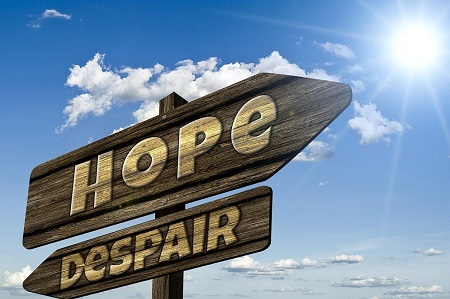
Keep Your Head--Hope and Despair arrow signs pointing opposite directionsWhen life goes out of control, it’s hard to keep your head. Uncertainty leads to panic rather than patience.

Keep your head means to remain calm.

Although everything around you falls apart at the seams, you don’t. Instead, you find calm in the middle of the storms.

Keep your head does not mean you never feel stressed.

With so much turmoil in the world today, stress affects everyone. Daily news bombards us with updates on:

  • Wars
  • Price increases
  • Abuse
  • Disasters
  • Crime

Everything goes haywire. Yet you find personal control in the worst of it.

Rather than give in to problems, get a grip on solutions.

As a former teacher often said, “Think. Just think.” Apply the good sense God gave you.

Choose:

  • Faith over fear
  • Hope over despair
  • Peace over pressure
  • Calm in chaos

“But you, keep your head in all situations” (2 Timothy 4:5 NIV).

Thanks to Joanne Viola for the suggestion. Image by Gerd Altmann from Pixabay.

Do you have an expression you want explained or a thought about this one? If so, please comment below.

Subscribe to receive my weekly posts by email and receive a free copy of “Words of Hope for Days that Hurt.”

If you enjoyed this post, please share it with your friends.